Storm in a Bhar
THIS IS A WORK OF FICTION
By four in the afternoon the tea stall beside Shobhabazar Metro had acquired its usual parliament: two unemployed graduates with immaculate hair, one retired insurance clerk who knew the private habits of every minister since 1977, three delivery riders leaning on their scooters like defeated cavalry, and a boy in a school uniform buying cigarettes for an uncle who, like all such uncles, existed in theory but never appeared.
The stall was wedged between a coaching center and an old house whose balcony had cracked into a permanent expression of aristocratic disgust. Above it hung tram wires, cable wires, puja-light wires left over from last year, and one political banner declaring CHANGE IS COMING in letters so sun-faded that change itself seemed to have lost confidence.
Arka sat on the wooden bench with a glass of tea and a small black instrument beside his elbow.
Nobody trusted the instrument.
It had a round mouth like a toy loudspeaker, three brass fins, and a blinking green eye. It looked too expensive for the stall and too shabby for a laboratory, which is how most dangerous things enter Bengal.
“Again this machine?” said Gopal-da, the tea seller, pouring milk from one dented aluminium pot to another. “Last week it spoiled my radio.”
“It did not spoil your radio,” Arka said.
“Then why was Lata Mangeshkar sounding like a traffic constable?”
“That was atmospheric interference.”
“Everything is atmospheric interference when you cannot pay compensation.”
The adda approved this. A small laugh went around, affectionate and cruel. In Calcutta, laughter is often how people check whether you are still socially alive.
Arka had once been very alive. He had gone to Bengaluru, then Singapore, then briefly to Munich, where people used umbrellas properly and weather came with polite warnings. He had modeled monsoon turbulence for a climate insurance company that sold protection to people who could already afford walls. Then his mother fell on the wet staircase of their crumbling house near Ahiritola, his father’s blood pressure began behaving like a communist procession, and Arka came back to Calcutta with a laptop, debts, and the private shame of the returned son who had not returned victorious.
Now he did freelance simulations for disaster consultants, startup founders, municipal committees, and once, memorably, a wedding decorator who wanted to know whether December fog would ruin an outdoor drone entry for the bride.
The black instrument was called a Micro-Vorticity Induction Recorder. Gopal-da called it the Jontro.
Arka had built it from discarded medical sensors, a miniature LiDAR unit, a barometric chip ordered from China, and a piece of code he had written during three feverish nights of insomnia. It measured the small confusions in air: the wobble above boiling tea, the swirl from a ceiling fan, the sigh of a passing bus, the invisible quarrel between heat and dust.
He was trying to prove a thing no one had paid him to prove.
He believed Calcutta’s storms were becoming locally triggered by micro-urban heat pockets—tin roofs, air-conditioner exhaust, concrete towers, open drains, metro vents, traffic islands, frying oil, human breath, old water, new glass. The city was no longer receiving weather. It was participating in it.
This was not a fundable sentence.
“Arka,” said Paltu, one of the unemployed graduates, “explain again. If I blow on this tea, America gets cyclone?”
“Not America,” Arka said. “And not exactly.”
“Japan then.”
“No.”
“Behala?”
“Behala is already beyond prediction.”
They laughed again.
The other graduate, Mithun, who had passed physics honors and now taught Class IX boys Newton’s laws in a coaching center named Quantum Career Temple, leaned forward. “Chaos theory means a butterfly flaps wings in Brazil and tornado in Texas. Correct?”
“Popularly, yes,” Arka said.
“Then our version is one Bengali talks too much over tea and whole para collapses.”
“Much more accurate,” said the retired insurance clerk.
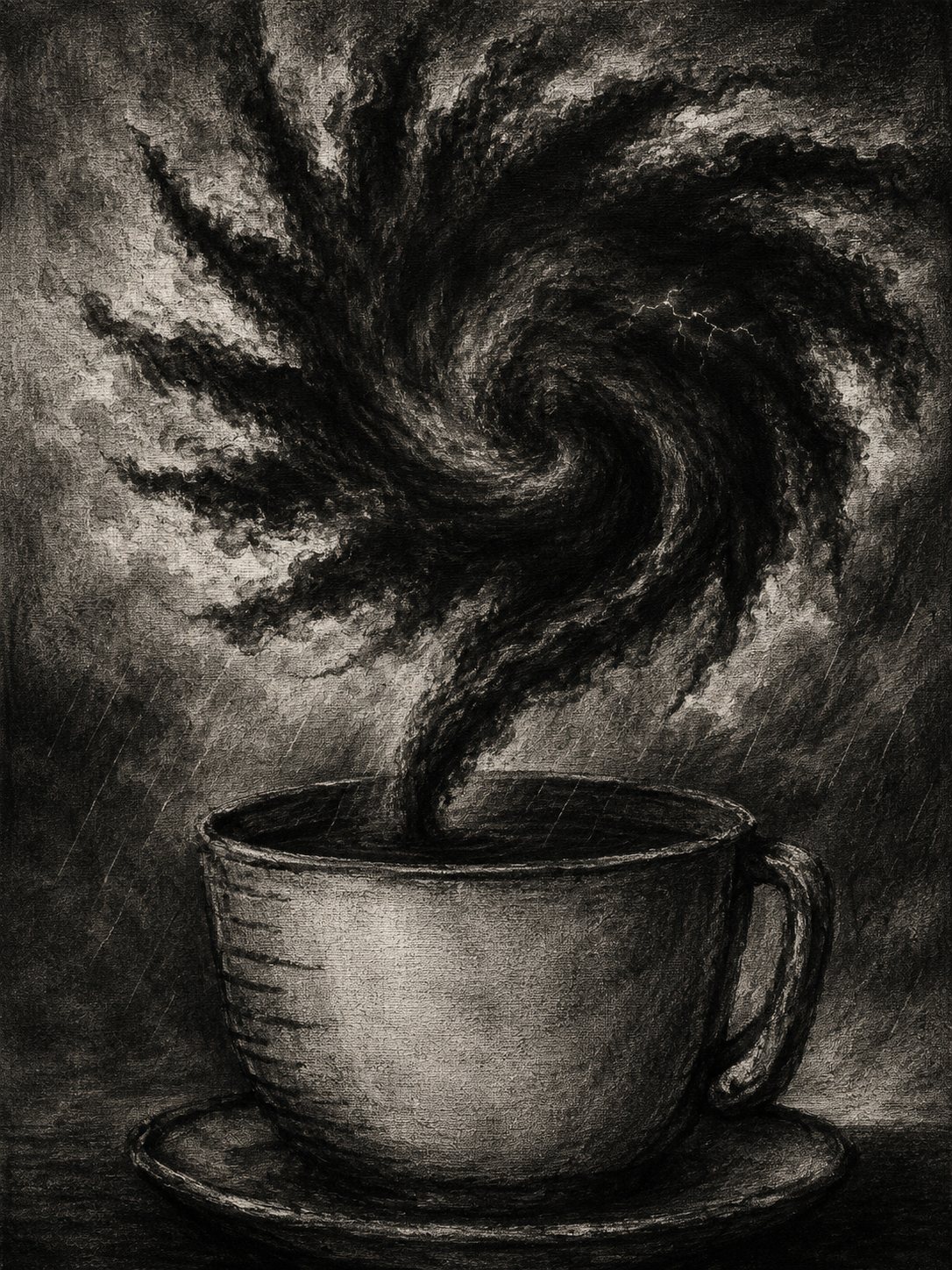
Gopal-da placed a fresh cup before Arka. Not glass this time, but a clay bhar, its rim dark with overboiled tea, steam lifting in a soft trembling column. The steam leaned left, straightened, split briefly like a forked tongue, then folded back into itself.
The instrument blinked faster.
Arka noticed.
He should have reached for it.
Instead he looked at the steam.
There are moments in science that do not arrive like discovery. They arrive like mischief. Newton’s apple, Archimedes’ bath, the mosquito that gives a tired man malaria and a theory of empire. Arka saw, above a two-rupee clay cup, a rotating filament of warm moist air hook itself into the cross-breeze from the metro entrance. The little hook tightened. The brass fins of the instrument trembled.
On the phone screen, numbers climbed.
Paltu blew gently at the cup.
“Don’t,” Arka said.
But the word came out lazily, as though from another room.
Paltu grinned. He made a dramatic face, cheeks swelling, lips pursed like a cinema villain sending poison through a flute, and blew again.
The steam collapsed into a black-looking knot.
Not black in color. Black in behavior. A small absence where the air refused to behave like air.
The green eye on the instrument turned red.
Then the tea in the cup shivered.
Gopal-da said, “Oof, drama.”
Above the bhar, the knot spun once, no larger than a betel nut. It lifted a ring of steam, then a second ring. The rings did not disperse. They stacked themselves, each one thinner, faster, more exact, like a child building a tower from bangles.
The schoolboy dropped his cigarette packet.
Somewhere high above Chitpur Road, a kite that had been floating in the dull afternoon turned sharply west though there was no west wind.
Arka grabbed the instrument. The screen had stopped displaying numbers. It displayed one word he had added as a joke during testing:
RUN.
The first gust arrived like gossip—quick, sideways, and carrying too many things at once. Dust from the metro steps. A receipt from the pharmacy. The smell of frying telebhaja. A torn coaching-center flyer promising IIT success through discipline. The flame under Gopal-da’s kettle flattened blue.
“Kalbaishakhi,” said the insurance clerk, pleased to identify something.
“In May, of course Kalbaishakhi,” said Gopal-da. “What is special?”
But it was not coming from the horizon.
Nor’westers in Calcutta usually announce themselves with theater. The sky bruises. Crows panic. Clotheslines snap like moral arguments. The air grows greenish and full of leaves. This storm began at face level, as if the street itself had inhaled.
The tea in every cup on the stall began rotating anticlockwise.
Then all the cups cracked.
People ran, which in North Calcutta is never simple because every lane already contains a handcart, a scooter parked by a philosopher, three arguing men, a sleeping dog, and a drain cover that vanished during the previous administration. The delivery riders tried to pull their scooters upright. The schoolboy bolted into the metro. Gopal-da shouted for his kettle, then for his cash box, then for his deity calendar, proving that theology comes after liquidity but before furniture.
Arka stayed just long enough to see the little black knot rise past the stall’s tarpaulin roof.
It touched the political banner.
The banner did not tear. It twisted into a rope and shot upward.
After that the city began to speak in breaking sounds.
By five, the storm had taken a narrow, vicious path through North Calcutta. It did not flatten everything. That would have been easier to understand. It selected.
A new glass-fronted coaching center lost every window but not its signboard. A century-old mansion on Madan Mohan Tala Street dropped its balcony onto a parked sedan, sparing the tea stall below. Tin roofs peeled off like old scabs. Satellite dishes flew. A puja pandal frame stored in a lane lifted, rotated with almost comic dignity, and lodged itself in the second-floor bedroom of a family who had spent twenty years refusing to donate to that puja.
The local news called it a freak storm cell. Then an urban microburst. Then, after one meteorologist used the phrase “unusual low-altitude rotational genesis,” channels discovered animation. By evening, every Bengali with a smartphone had seen a red spiral drawn over North Calcutta and had become an expert in atmospheric collapse.
Arka’s father watched the news from bed, his blood pressure machine still strapped to his arm.
“So your area,” he said.
“Yes.”
“Very bad.”
“Yes.”
“Any work possibility from this?”
Arka looked at him.
His father looked back calmly. Middle-class fathers are practical in a way that can be mistaken for cruelty, but is usually panic wearing a pressed shirt.
“Disaster modeling,” his father said. “You know these things.”
Arka went to the bathroom and vomited tea.
That night the power went out. The generator in the new gated tower nearby started with a wealthy cough. In the old houses, people stood on balconies and judged the darkness.
Arka sat beside his mother, who was asleep under a thin sheet, her plastered leg lifted on pillows. The rain had stopped but water still dripped somewhere inside the wall. His phone kept vibrating.
Mithun: Brother u alive?
Paltu: Dada that was not my blow right? 😂
Unknown number: Sir, media wants byte.
Unknown number: Are you Dr Arka Sen atmospheric scientist?
Unknown number: We are from Eastern Impact Analytics. Urgent consulting opportunity.
Then one message from Gopal-da:
Come tomorrow morning. Bring machine. Police came.
Arka did not sleep. He replayed the data from the Jontro. There was only seven seconds of usable recording before the sensor saturated. But those seven seconds were impossible. A rising thermal plume above tea should have scattered into ordinary turbulence. Instead it had phase-locked with vibrations from the metro escalator, pressure pulses from traffic, exhaust heat from a momo steamer, and the standing wave created by the alley’s geometry.
A city is a machine that pretends to be a place.
He had written that once in a proposal. Nobody funded it.
At three in the morning he found an older file on his laptop named BHAR_TEST_03.
He had not created it.
The file contained a simulation dated eight months earlier, before he had assembled the instrument. Same location. Same wind speed. Same cup temperature. Same predicted vortex.
At the bottom, in the notes field, was one sentence:
Subject will require guilt before cooperation.
Arka shut the laptop.
Then he opened it again, because fear is strong but curiosity is a hereditary Bengali disease.
The file metadata listed the author as ASen.
His own initials.
But the device ID was not his Jontro.
It was a government meteorological tag.
The next morning, Shobhabazar looked like the city had woken after a drunken fight and was pretending not to remember. Men swept glass into piles. A woman scolded a fallen tree for blocking her doorway. Delivery riders photographed damage they would later use as proof for late orders. A municipal worker tied danger tape around a leaning lamppost, which immediately leaned harder.
Gopal-da’s stall had survived, though its tarpaulin roof now hung like a tired tongue.
Police had come and gone. So had a reporter who wanted footage of the “tea cyclone.” Gopal-da had given three interviews and increased the price of tea by one rupee.
“Scientific surcharge,” he explained.
Mithun was there, pale and excited. Paltu was not.
“Where is he?” Arka asked.
“Home,” Mithun said. “His mother locked him in. She thinks he caused it.”
“He did not.”
Mithun looked at the black instrument under Arka’s arm. “Did he?”
A white Ambassador, so clean it seemed immoral, stopped beside the stall. From it emerged a woman in a cream cotton sari and sneakers. She was in her late fifties, hair cut short, face unadorned, eyes sharp with the old Calcutta habit of seeing through price tags.
“Dr. Arka Sen?” she said.
“Nobody calls me doctor.”
“That is rarely a scientific objection.”
She introduced herself as Professor Ishani Lahiri, formerly of the Indian Institute of Tropical Systems, currently consultant to agencies she did not name. She looked at the stall, the wires, the broken cups, the scorched kettle, the metro entrance breathing commuters into the heat.
“Good,” she said.
“Good?”
“Contained.”
Arka stared.
Gopal-da, sensing someone official, wiped the bench with a cloth that made it dirtier.
Professor Lahiri ordered tea without sugar. Then she pointed at Arka’s instrument.
“You built the child version.”
“I built my version.”
“You found our old designs.”
“I found parts. Papers. Public patents.”
“And the model?”
Arka said nothing.
She smiled faintly. “Ah.”
Mithun leaned closer. “Madam, is this about chaos theory?”
Professor Lahiri considered him. “Chaos theory is what we call it when mathematics becomes honest enough to admit it cannot babysit every molecule.”
Gopal-da nodded as if this confirmed long-held suspicions.
She turned back to Arka. “Your father worked in instrumentation procurement for twenty-three years.”
“So?”
“He brought home things.”
“My father brought home office pens and blood pressure.”
“And one drive.”
The city made a small noise around them: hammers, buses, bicycle bells, a hawker singing mango prices as if auditioning for grief. Arka remembered his father’s locked drawer. Old receipts. Rusted keys. A blue pen drive shaped like a cartoon fish. He had found it during the months after returning, when he was searching for insurance papers and dignity in the same furniture.
He had copied everything.
Most files were corrupted.
Some were not.
Professor Lahiri sipped her tea. Above the cup, steam rose meekly.
“In the late 1990s,” she said, “we studied localized storm initiation in dense urban basins. Calcutta was ideal. Moisture, heat, old architecture, new concrete, river influence, human density, electrical noise. A laboratory with fish markets.”
“You triggered storms?”
“We studied whether storms could be nudged.”
“That means triggered.”
“It means nudged.”
“And yesterday?”
“That was you.”
Arka felt, absurdly, offended by the simplicity.
Professor Lahiri softened by half an inch. “Not morally. Technically.”
Mithun whispered, “Dada, you are famous.”
“No,” Arka said. “I am liable.”
Professor Lahiri looked toward the cracked balcony across the street. “Do you know what would have happened yesterday evening without the release?”
Arka did not answer.
She took out her phone and showed him a map. A red mass had been building over the Hooghly, larger than the one that struck. Its projected path ran across Belgachia, Maniktala, Sealdah, Salt Lake, the airport corridor. Wind shear. Heat loading. A stalled pressure boundary. The kind of storm that would not merely break windows but roofs, cranes, flyovers, hospital backup lines.
“Your little vortex vented the system early,” she said. “Ugly, but narrow. Like lancing a boil.”
“That is disgusting.”
“Also accurate.”
He wanted to believe her. That was the worst part. Belief would reduce his guilt to usefulness, and usefulness is the drug by which educated middle-class men forgive themselves for almost anything.
“Why was there a file on my laptop?” he asked.
Professor Lahiri did not blink. “Because your father sent us a message when you copied the drive.”
“My father?”
“He wanted work for you.”
A tram bell rang somewhere far away, though no tram passed.
“He what?”
“He said you had come back. He said you were wasting your mind on small contracts. He asked whether the old project could use someone who understood modern code.”
“My father doesn’t know what code is.”
“Parents rarely understand the instrument. They understand the wound.”
Arka thought of his father in bed, asking about work possibility while destruction crawled across the television screen. He had thought it was opportunism. Perhaps it was worse. Love.
Professor Lahiri placed a card on the bench.
“Urban storms are changing,” she said. “We need people who know the city at cup level, not satellite level. There will be more releases. Controlled ones, ideally. You can help make them safer.”
“Or refuse.”
“Yes.”
“What happens if I refuse?”
She looked at the tea stall, where Gopal-da was already telling a new customer that the storm had personally started in his best clay cup.
“Then someone less guilty will do it.”
That evening Arka went home through lanes still wet from broken pipes and rainwater. North Calcutta smelled of dust, mango leaves, old brick, and electrical burning. Children sailed paper boats in a gutter carrying fragments of somebody’s ceiling. An old man sat under a torn poster of a smiling candidate and read the newspaper by the light of his phone.
At home his father was awake.
“You gave them my name,” Arka said.
His father closed his eyes briefly, then opened them. “I gave them your number.”
“Why?”
“You were disappearing in front of us.”
“So you thought weather weaponry would cheer me up?”
“It is not weaponry.”
“That is exactly what people say before weaponry.”
His father smiled, tired and irritating. “You always needed big problem.”
“I needed rent.”
“Same thing in Calcutta.”
Arka almost laughed. Instead he sat beside the bed.
His father reached under the pillow and took out the blue pen drive shaped like a fish.
“I kept original,” he said.
Arka looked at it.
“How much did you know?”
“Very little. Enough.”
“Enough for what?”
His father’s hand trembled, whether from age or fear Arka could not tell.
“Enough to know your mother did not fall by accident.”
The room tightened.
Rain ticked against the iron grille.
“What?”
“Three months ago,” his father said, “small wind came in staircase. Like hand. Pushed her.”
“That’s absurd.”
“Yes.”
But he was not smiling.
Arka remembered the wet staircase, his mother’s cry, the brass plate spinning at the landing, the window at the top banging open and shut in air that had seemed strangely warm. He remembered, too, the Jontro prototype on his desk that day, running unattended beside a cup of tea gone cold.
His father placed the pen drive in Arka’s palm.
“Some storms ask to be born,” he said. “Some people help without knowing.”
The power returned with a hard white flicker. The ceiling fan began turning. On the bedside table, his father’s tea sat untouched in a steel cup.
Above it, the steam leaned left.
Straightened.
Split like a forked tongue.
Arka closed his fingers around the pen drive, and very gently, before the little dark knot could climb, he put his mouth to the rim and drank the storm down.